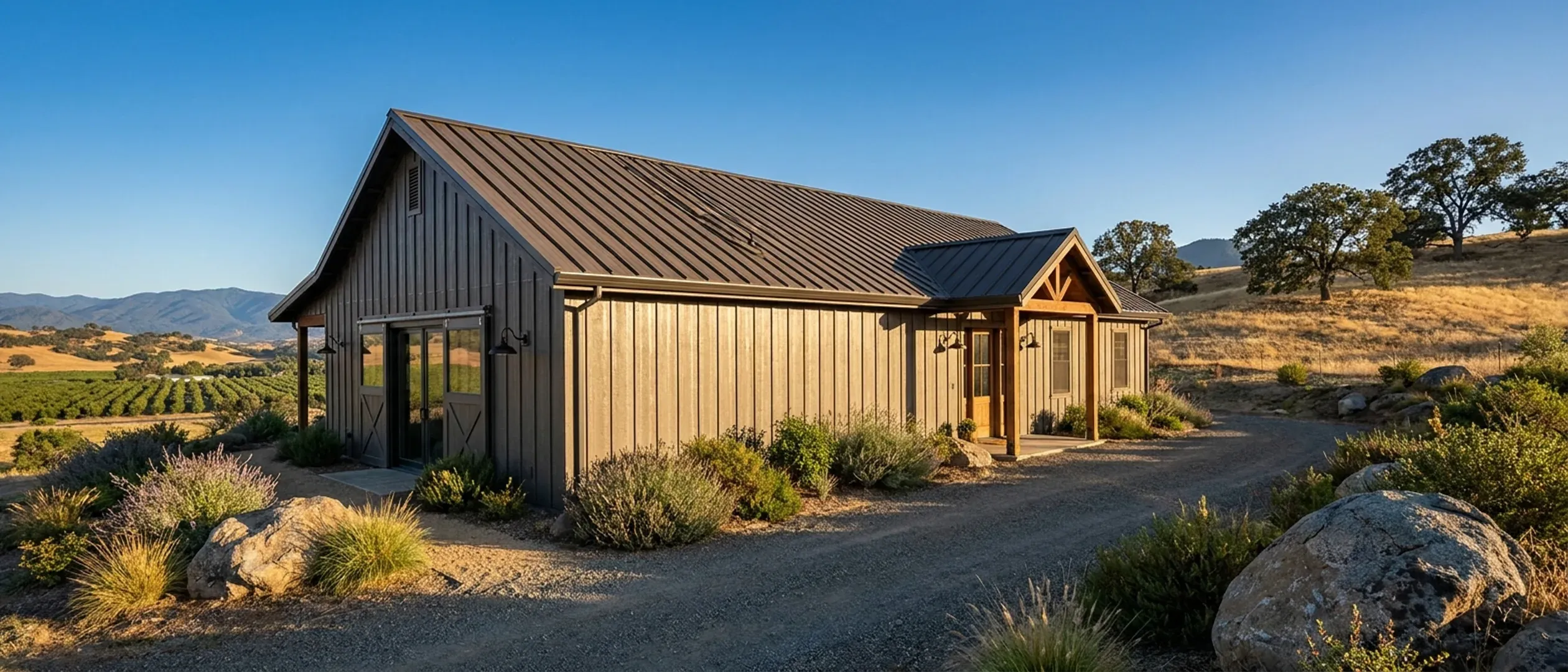
Are Barndominiums Worth It in California? Land and Insurance
Whether a barndominium is worth it in California depends far more on the parcel and on what you need the building to do than on the steel. It is usually worth it for someone who wants a large shop, equipment bay or garage and a home under one roof, on rural land where that fits, and who plans for the state's conditions from the start. It is usually not worth it for someone choosing it only because it is supposed to be cheap, or for a city lot where there is no room for what makes the building type useful. This page sets out both cases, the California-specific costs that apply to every new home and so do not favour either option, how appraisal and insurance really work, and the questions that settle it for a particular piece of land.
Figures on this page are cited third-party or government data, not a quote from California Barndominium Builders.
Bottom Line Up Front
- Worth it: when you need a shop and a home together, you have or can find rural land that allows a dwelling with water and septic, and you design for fire, heat and seismic loads from the start.
- Not worth it: when the only reason is price, when the parcel is in a dense city, or when you cannot confirm water, septic and insurance for the land before you buy.
- Every new California home carries the same state code items, so the saving, where there is one, is in the shell and the shop space, not in skipping anything.
When a barndominium is usually worth it
These are the situations in which the building type earns its place.
You need a shop and a home together
A clear-span building puts a workshop, equipment bay, RV garage or hobby space under the same roof as the house. If you would otherwise build a house and a separate shop, this is where a barndominium makes the most sense. See shouses.
You have, or can find, the right rural land
A parcel where a dwelling is allowed, with a workable water source and soil that will take a septic system, is the foundation of the whole decision. In the Valley, the foothills, the Central Coast inland valleys and the High Desert that kind of land exists; inside the dense coastal cities it mostly does not. See service areas.
You are planning for fire, heat and earthquakes anyway
If you intend to harden the house against embers, insulate properly for summer heat and build to an engineered design, a barndominium fits those goals as well as any house, and its metal roof counts toward the insurance discount.
You want to manage part of the build yourself
Some buyers act as owner-builder on their own land and hire licensed trade contractors directly. California lets you act as an owner-builder on your own land, doing the work yourself or hiring licensed trades directly, and you sign an owner-builder declaration with the permit. Selling within a year of completion raises a presumption that you built to sell. See barndominium kits.
When it usually is not
In these cases the answer is often no, or not yet.
The only reason is price
The shell can cost less per square foot than framing, but the foundation, trades, finishes, site work and state code items cost the same as in any house. A buyer who wants a conventional home and chooses a barndominium only to save money is often disappointed. The barndominium vs house cost guide compares them with third-party figures.
The parcel is in a dense city
In San Francisco, Oakland, Long Beach, Anaheim, most of Los Angeles and most of San Jose there is little or no acreage, and the building type loses the space that makes it useful. The rural counties and the High Desert are where the land is.
Water, septic or insurance cannot be confirmed
If the well, the septic system or a policy for the parcel cannot be confirmed before purchase, the building type is not the problem, the land is. Do not buy until each of those has an answer.
You need to sell soon
Resale depends on similar sales nearby. In areas with few barndominiums, both the appraisal and the pool of buyers can be thinner than for a conventional house.
Resale and appraisal, stated honestly
What the lending rules actually say, with no promise about any market.
Nontraditional housing is financeable when it can be valued
Fannie Mae's Selling Guide says loans secured by unique or nontraditional housing are eligible provided the appraiser has adequate information to develop a reliable opinion of market value. How easy that is depends on the differences from nearby houses and how many similar properties have sold in the area.
Rural comparables are thin
The same guide asks for comparable sales closed within the last 12 months, and recognises that in a rural area with minimal sales activity an appraiser may not find three truly comparable recent sales. Expect the appraiser to reach further for comparables.
A big shop can raise a question
Fannie Mae says significant outbuildings such as large barns or storage areas may indicate the property is agricultural in nature, and the lender must decide that it is residential. Keep the home clearly the main use and talk to the lender about the shop early. See the financing guide.
No one can promise a resale value
Resale depends on the local market, the finish level and how the home compares with what buyers in that area are used to. A finish and layout that read as a house, not a barn, generally widen the pool of buyers.
What to check before deciding
Answer these for the actual parcel. They settle the question better than any general rule.
Does the zoning allow a dwelling, and in what form?
Ask the county or city planning department, and ask whether the land is under a farmland conservation contract or inside the coastal zone.
Is the parcel in a Fire Hazard Severity Zone?
Check the address on the State Fire Marshal's Fire Hazard Severity Zone viewer and ask the city or county which map it has adopted. In a zone, the California Wildland-Urban Interface Code applies to the build and defensible space rules apply around it.
Where will the water come from?
Public water, a shared system or a new well. Ask the county environmental health department what a well permit requires on that parcel.
Will the soil take a septic system?
Ask the county environmental health department what testing it requires before a septic permit, and do that before you buy.
Can you insure it?
Get quotes from more than one insurer on the specific parcel and building, and ask what Safer from Wildfires discounts they give.
Reading this because you are weighing a build? The next step is a plan drawn for your program.
What's different about California
The land decides first
Whether a home can go on a parcel is a county or city zoning question first. Land under a Williamson Act contract is restricted to agriculture and uses the county finds compatible, in exchange for lower property taxes, and in the Coastal Zone building needs a coastal development permit as well as the building permit. The legal guide sets out the decision path for a parcel: zoning, farmland contracts, the coastal zone, fire zones, water and septic, then the building code.
Water and septic are part of the price
Septic systems are permitted locally, usually by county environmental health, under the State Water Board's OWTS Policy, and water wells are permitted by the county (or a city or water agency) and drilled by a C-57 licensed well contractor. On a rural parcel the well and the septic system can be among the largest single line items, and they are the ones that can stop a project, so confirm both before buying.
Insurance in fire country
The Department of Insurance tells buyers to shop the market first and describes the California FAIR Plan as available to people who cannot obtain insurance through a regular insurer. Under its Safer from Wildfires regulation, insurers must offer discounts for listed mitigation steps, including a Class A roof, which it says metal sheets qualify as, and must tell you your wildfire risk score when you apply. Get quotes on the specific parcel before you commit to it.
State code items apply to every new home
New one- and two-family homes in California need an automatic fire sprinkler system under the California Residential Code (Section R309), installed by a licensed fire-protection contractor. Under the 2025 Energy Code a new single-family home generally also needs a solar PV system sized by a state formula; roofs with too little sunny area and very small required systems are exempt, and a qualifying battery can reduce the required size by 25 percent. A barndominium carries them the same as a conventional house, so they do not change which option is cheaper. They do change the total, and the cost guide covers each of them.
Taxes and fees on top of the build
Kit materials bought in California carry sales tax at the 7.25 percent statewide base rate, plus local district taxes in most areas. School districts can charge impact fees on new homes, and when the home is finished the county assessor adds its value to your property tax base. The County of San Diego's own permit guidance warns that impact and agency fees, such as school and fire mitigation fees, can be a sizeable amount, so ask the building department for a fee estimate early.
Climate cuts both ways
A long, dry Valley summer suits building, and a metal roof qualifies as Class A for the insurance discount. On the other side, average July highs near 98 degrees at Fresno, Bakersfield and Redding on the Western Regional Climate Center's records mean the envelope has to be designed for heat, and the U.S. Geological Survey puts the 30-year chance of a magnitude 6.7 or larger earthquake in the California region above 99 percent.
Pros and cons, honestly
Pros
- Shop, garage or equipment bay and home under one roof
- Metal roofing qualifies as Class A for Safer from Wildfires insurance discounts
- Long dry Valley summers suit construction
- Fits an owner who wants to manage part of the build on their own land
Cons
- Rural land with water and septic is the real constraint, and it is not everywhere
- Appraisal can be harder where few similar homes have sold
- Insurance must be confirmed parcel by parcel in fire country
- State code items and local fees apply to every new home, so the saving is smaller than the shell price suggests
- Dense coastal cities have little or no land for the building type
Are barndominiums worth it in California?
Is it cheaper to build a barndominium than a house in California?
Can you get a mortgage on a barndominium in California?
Can I insure a barndominium in wildfire country?
Do barndominiums hold their value in California?
Can I build a barndominium on my land in the city?
What is the biggest risk with a California barndominium?
Is a barndominium a good choice for a wildfire area?
Questions answered? Tell us what you want to build and we will put real numbers against it.
Sources
- Fannie Mae Selling Guide — B4-1.3-05, Improvements Section of the Appraisal Report
- Fannie Mae Selling Guide — B4-1.3-08, Comparable Sales
- California Department of Insurance — Safer from Wildfires
- California Department of Insurance — FAQ: Safer from Wildfires Regulation (PDF)
- California Department of Insurance — California FAIR Plan
- County of San Diego Planning & Development Services — How to Obtain a Building Permit Summary (PDS 441A, PDF)
- U.S. Geological Survey — Fact Sheet 2015-3009, UCERF3
- Western Regional Climate Center — Fresno Yosemite International Airport, monthly climate summary
Keep reading
The pages that answer the next question this one raises.
Barndominium pros and cons
The structural comparison behind this page: what a steel or pole barn shell does better and worse in California.
Read itCan you build a barndominium in California?
The decision path for a parcel: zoning, fire zones, water, septic, the building code and who may build.
Read itBarndominium cost in California
Third-party cost figures for shells, turnkey builds and the California code items.
Read itBarndominium financing in California
How lenders treat barndominiums, construction loans and appraisal.
Read itShouses
The shop-plus-house case in detail.
Read itWant a real number instead of a range?
Start the survey and tell us about your land and what you want to build. Include the county and parcel number (APN) if you have them, because in California the zoning, the fire hazard zone, the septic and well answers and the local fees change the budget as much as the building does. The survey costs nothing.