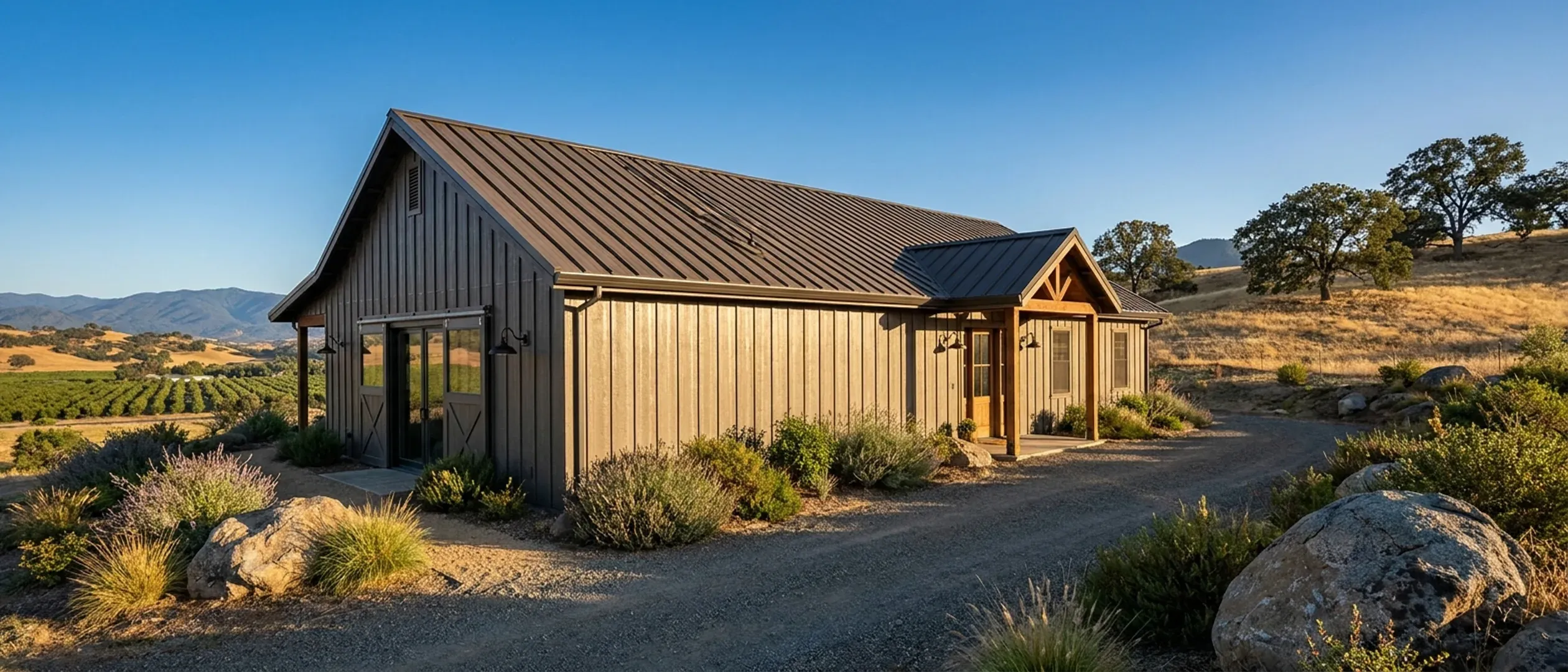
Can You Build a Barndominium in California?
Yes. Barndominiums are legal in California as homes: a barndominium people live in is permitted and inspected like any other site-built house under the California Building Standards Code (Title 24). But the answer is "yes, but" at every layer. The questions that decide whether you can build one belong to the parcel: whether the zoning allows a dwelling, whether the land is under a Williamson Act contract or inside the Coastal Zone, whether it sits in a Fire Hazard Severity Zone, how the house will get water and dispose of wastewater, and who will draw the plans and build it. This guide is written as a decision path for someone holding, or about to buy, a specific piece of land. Every rule in it is stated from the statute, code or agency page named in the Sources list, and none of it is legal advice for your parcel: the city or county that issues your permit has the final word.
Figures on this page are cited third-party or government data, not a quote from California Barndominium Builders.
Bottom Line Up Front
- A barndominium is legal in California as a site-built home under Title 24: the 2025 California Building Standards Code, in effect since 1 January 2026. A steel or pole barn kit is not a modular or manufactured home; it is permitted like any house.
- Whether you can build one on a particular parcel is decided locally: zoning and any Williamson Act contract by the county or city, a coastal development permit in the Coastal Zone, the septic system and well by county agencies, and the building permit by the city or county building department.
- Every new California home needs fire sprinklers and, in most cases, solar PV; homes in Fire Hazard Severity Zones are built to the California Wildland-Urban Interface Code; and a steel-frame home needs structural plans stamped by a licensed engineer or architect.
Start here: the decision path for your parcel
Work through these in order. Each one can stop or reshape a project, and none of them depends on whether the house is a barndominium.
1. Does the zoning allow a dwelling?
Ask the county planning department for unincorporated land, or the city's for land inside city limits. Ask what size and number of dwellings the zone allows, what setbacks apply, and whether a shop of the size you want is allowed with the house.
2. Is the land under a Williamson Act contract?
Land under a Williamson Act contract is restricted to agriculture and uses the county finds compatible, in exchange for lower property taxes. Whether you can build a home on it depends on the county's own Williamson Act rules, so check before you buy.
3. Is it in the Coastal Zone?
In the Coastal Zone, building needs a coastal development permit in addition to the building permit (Public Resources Code §30600). The zone generally runs about 1,000 yards inland from the mean high tide line and further in some areas, so confirm a coastal parcel's status on the Coastal Commission's map, not by distance.
4. Is it in a Fire Hazard Severity Zone?
Check your address on the State Fire Marshal's Fire Hazard Severity Zone viewer, and ask your city or county which map it has adopted. State-area maps took effect in April 2024, and cities and counties adopt the local-area maps by ordinance. If the parcel is in a zone, the California Wildland-Urban Interface Code applies to the build.
5. Where will the water come from?
Public water, a shared system or a well. Water wells are permitted by the county (or city or water agency) under state well standards and must be drilled by a C-57 licensed well contractor (Water Code §13801, §13750.5). In groundwater basins managed under the Sustainable Groundwater Management Act, ask the county and the local groundwater sustainability agency about well rules before you buy.
6. How will wastewater be handled?
Sewer, or a septic system. Septic systems in California are permitted locally, usually by county environmental health, under the State Water Board's statewide OWTS Policy; many counties run their own approved Local Agency Management Program with county-specific standards. Ask what the county requires on your parcel before you buy it.
7. Who will draw the plans and build it?
A steel-frame home needs stamped structural plans. The builder needs a licence from the Contractors State License Board unless you act as owner-builder on your own land. Both are covered below.
Land: zoning, farmland contracts, the coast and ADUs
The land questions come first because they decide whether any house is possible, and they are answered by the county or city, not the state.
Zoning is local
Each city and county zones its own land. A parcel described as "agricultural" or "rural" may allow one home, several, or none without a separate approval. The planning department's answer for the specific parcel is the one that counts.
Williamson Act contracts
The Williamson Act (the California Land Conservation Act of 1965, Government Code §51200) lets counties and cities contract with landowners to keep land in agricultural or related open-space use in return for much lower property tax assessments. Each contract excludes uses other than agricultural and those compatible with it (§51243), and the Department of Conservation says participating counties and cities set their own rules, including allowable and compatible uses. So the county's rules decide whether a home is possible on contracted land.
Coastal development permits
Anyone undertaking development in the Coastal Zone needs a coastal development permit in addition to any other permit (Public Resources Code §30600). It is a separate approval, so it belongs at the start of the schedule.
Accessory dwelling units
California's ADU law, recodified at Government Code §66310 and following by SB 477 (effective 25 March 2024), requires cities and counties to approve qualifying accessory dwelling units ministerially, without discretionary review or a hearing, under their objective local standards. An ADU can be rented but not sold separately from the main house. That does not make any particular barndominium-style unit automatically approvable: it still has to meet the local objective standards.
A home is a dwelling whatever it looks like
The state directs every city and county building department to enforce the State Building Standards Code for dwellings (Health and Safety Code §17960). If people will live in the building, plan on it being permitted as a home, with the code items every new California home carries.
Fire country: hazard zones, the WUI code and defensible space
Much of rural California is mapped for wildfire hazard, and a metal building does not take a parcel out of those rules.
Who maps the zones
The State Fire Marshal classifies land in state responsibility areas into Fire Hazard Severity Zones (Public Resources Code §4202), and those maps have been in effect since April 2024. For local responsibility areas the State Fire Marshal recommends zones and each city or county designates them by ordinance within 120 days, and may not reduce a zone the State Fire Marshal identified (Government Code §51179).
The California Wildland-Urban Interface Code
In the 2025 code, the wildfire construction rules moved to a new Part 7 of Title 24, the California Wildland-Urban Interface Code, in effect since 1 January 2026. It applies in state-identified Fire Hazard Severity Zones and other areas the enforcing agency designates, and its Chapter 5 sets rules for the roof (a Class A roof assembly), enclosed eaves, gutters, exterior walls, underfloor areas, projections such as decks, windows, doors, vents and accessory buildings.
Where metal fits
Metal roofing and noncombustible wall materials are among the options the code lists. Your building department confirms whether a specific product and assembly qualify, so choose the roof, wall, vent and window products with the code section in hand rather than assuming a metal building complies.
Roof class by statute
Separately, Health and Safety Code §13132.7 requires a Class A roof in very high Fire Hazard Severity Zones, at least Class B in state responsibility areas outside moderate zones, and at least Class C elsewhere.
Defensible space, and Zone 0
In state responsibility areas and in very high hazard zones designated by a local agency, owners must keep 100 feet of defensible space around a structure (Public Resources Code §4291; Government Code §51182). A stricter 0 to 5 foot ember-resistant "Zone 0" was adopted by the Board of Forestry on 19 August 2026 and takes effect when it is filed with the Secretary of State after Office of Administrative Law review; it was not yet in effect on 27 September 2026, and from its effective date it applies to new building permits immediately. Some local fire codes already require a near-home zone of their own (for example, unincorporated San Diego County's 2026 Wildland-Urban Interface Code, effective 2 April 2026, requires hardscape or noncombustible material within 5 feet of the building), so check with your city, county or fire district.
Water and wastewater
On most rural parcels the well and the septic system are separate county permits, and they are the ones most likely to stop a project.
Septic systems: the OWTS Policy and county programs
The State Water Board sets the statewide standards for onsite wastewater treatment systems (Water Code §13291) through its OWTS Policy, and local agencies, usually county environmental health, permit the systems. Where a county has an approved Local Agency Management Program, that program's standards apply and can differ from the statewide Tier 1 requirements, so the rules for your parcel come from your county.
Wells: county permits, state standards
Each county, city or water agency adopts a well ordinance that meets or exceeds the state's well standards (Water Code §13801), and wells must be drilled by a contractor holding a C-57 Water Well Contractor's License (§13750.5).
Groundwater basins under SGMA
Where a groundwater basin is managed under the Sustainable Groundwater Management Act (Water Code §10720 and following), ask the county and the local groundwater sustainability agency about well rules before you buy.
Do these before you buy
If the county cannot approve a septic system or a well for the parcel, the building type does not matter. Ask both questions, in writing if you can, before the purchase closes.
Kit, modular or manufactured: which program applies
The word on the listing does not decide the rules; the way the house is built does.
Modular means factory-built housing
Factory-built housing is manufactured off site in a way that concealed parts cannot be inspected before installation (Health and Safety Code §19971), and it must bear the insignia of approval issued by the Department of Housing and Community Development (§19980). The local building department handles the foundation and installation.
Manufactured means the HUD code
A manufactured home is built to the federal HUD code on a permanent chassis (Health and Safety Code §18007). Cities and counties must allow manufactured homes on a foundation on single-family lots (Government Code §65852.3).
A barndominium kit is site-built
A steel or pole barn kit is shipped as parts and erected on your land. It fits neither definition above, so it goes through plan check and inspection like any site-built home under the California Residential Code. See barndominium kits.
Who may build it
Consumer information from the Contractors State License Law, so you can check anyone you hire.
Builders need a CSLB licence
In California, anyone who builds, or offers to build, a home for someone else needs a licence from the Contractors State License Board: the law treats "builder" and "contractor" as the same thing (Business and Professions Code §7026). Licensees must include their licence number in their contracts and advertising (§7030.5). Check any licence on CSLB's website before you sign.
Kit sellers and installers
A company that only sells a kit, and does not install it or contract for its installation, is not a contractor under the licence law (§7045). Once it erects the kit, or arranges for it to be erected, it is.
Owner-builders
You can act as an owner-builder on your own land, doing the work yourself or with your own wage employees, or hiring licensed trade contractors directly (§7044), and you sign an owner-builder declaration with the permit application (§7031.5; Health and Safety Code §19825). Selling within a year of completion raises a presumption that you built to sell.
No small-job loophole for a house
According to §7048, the minor-work exemption covers only jobs under $1,000 in total that need no building permit, so it never covers a house.
Paying an unlicensed contractor
If you pay an unlicensed contractor, you can sue to get the money back, and the unlicensed contractor cannot sue you for payment (§7031).
Trades and wells are licensed work too
Fire sprinklers are installed by a licensed fire-protection contractor and wells by a C-57 licensed well contractor. Licensed trade contractors handle plumbing, electrical, HVAC and solar.
Reading this because you are weighing a build? The next step is a plan drawn for your program.
What's different about California
One state code, enforced locally
California homes are built to the California Building Standards Code, Title 24 of the California Code of Regulations. For a house the core part is the California Residential Code, and the current edition, the 2025 code based on the 2024 International Residential Code, took effect on 1 January 2026. Health and Safety Code §17960 directs the building department of every city and county to enforce the State Building Standards Code for dwellings within its jurisdiction, so your city's building department issues and inspects the permit inside city limits, and in unincorporated areas it is the county's.
Local amendments, and a freeze on new ones
Cities and counties can change the state code where it is reasonably necessary because of local climatic, geological or topographical conditions (Health and Safety Code §17958.5), with express findings. But under §17958.5(c), from 1 October 2025 to 1 June 2031 a city or county generally may not make new changes that apply to residential units unless they were in effect on 30 September 2025, are emergency standards or relate to home hardening against wildfire. In practice: cities and counties can keep local amendments they adopted before October 2025 and can add wildfire home-hardening rules, but a state moratorium blocks most new local building-code changes for homes until June 2031.
Design figures belong to your site
The California Residential Code leaves snow load, wind speed, frost depth and seismic design category to the local jurisdiction, which sets them out in the code's Table R301.2. So those figures are set for your site by the local building department, and a barndominium frame has to be designed to them. A kit priced for one part of the state is not automatically right for another.
Sprinklers and solar come with every new home
New one- and two-family homes in California need an automatic fire sprinkler system under the California Residential Code (Section R309), installed by a licensed fire-protection contractor; detached accessory dwelling units of up to 1,200 square feet on the same lot as an unsprinklered house are an exception. Under the 2025 Energy Code (Title 24, Part 6, §150.1(c)14), a new single-family home generally needs a solar PV system sized by a state formula based on floor area and climate zone; roofs with too little sunny area and very small required systems are exempt, and adding a qualifying battery can reduce the required size by 25 percent.
Steel frames need stamped plans
Business and Professions Code §5537 and §6737.1 let anyone prepare plans for single-family dwellings of wood-frame construction not more than two stories and basement in height. A steel-frame home falls outside that exemption, as does any part of a house that goes beyond conventional wood framing: it needs structural plans and calculations stamped by a licensed engineer or architect (§6735). Expect your building department to ask for engineered, stamped structural plans for a steel barndominium.
A kit is not a modular or manufactured home
In California, "modular" homes are factory-built housing: built in a factory under the Department of Housing and Community Development's Factory-Built Housing program and carrying a state insignia, with the local building department handling the foundation and installation (Health and Safety Code §19971, §19980). Manufactured homes are built to the federal HUD code on a permanent chassis (§18007), and cities and counties must allow them on a foundation on single-family lots (Government Code §65852.3). A steel or pole barn barndominium kit is neither: it is shipped as parts and erected on your land, so it is permitted and inspected like any site-built home under the California Residential Code.
Are barndominiums legal in California?
Are barndominiums allowed in California's farmland and rural areas?
Do I need a permit to build a barndominium in California?
Does a steel barndominium need an engineer in California?
Does a barndominium need fire sprinklers and solar panels in California?
Is a barndominium kit a modular or manufactured home?
Can I build a barndominium in a Fire Hazard Severity Zone?
Can I be my own builder?
Can I build a barndominium as an ADU?
Can a city or county add its own rules for barndominiums?
Questions answered? Tell us what you want to build and we will put real numbers against it.
Sources
- California Building Standards Commission — 2025 California Building Standards Code (Title 24)
- ICC Digital Codes — 2025 California Residential Code (Title 24, Part 2.5)
- ICC Digital Codes — 2025 California Wildland-Urban Interface Code (Title 24, Part 7)
- California Health and Safety Code §17960 (enforcement by city and county building departments)
- California Health and Safety Code §17958.5 (local amendments and the 2025–2031 moratorium)
- California Energy Commission — 2025 Building Energy Efficiency Standards
- California Business and Professions Code §5537 (who may prepare plans without an architect)
- California Business and Professions Code §6737.1 (who may prepare plans without an engineer)
- Office of the State Fire Marshal — Fire Hazard Severity Zones
- California Public Resources Code §4291 (defensible space)
- California Government Code §51179 (local designation of Fire Hazard Severity Zones)
- California Health and Safety Code §13132.7 (roof covering class)
- Board of Forestry and Fire Protection — Defensible Space Zones 0, 1 and 2
- County of San Diego — Create defensible space
- State Water Resources Control Board — Onsite Wastewater Treatment Systems (OWTS Policy)
- California Water Code §13801 (county well ordinances)
- California Water Code §13750.5 (C-57 well contractor licence)
- California Water Code §10720.7 (Sustainable Groundwater Management Act basins)
- California Department of Conservation — Williamson Act Program
- California Government Code §51243 (Williamson Act contract terms)
- California Public Resources Code §30600 (coastal development permits)
- California Department of Housing and Community Development — Accessory Dwelling Units
- California Government Code §66317 (ministerial ADU approval)
- California Department of Housing and Community Development — Factory-Built Housing
- California Department of Housing and Community Development — Manufactured Housing
- California Health and Safety Code §19971 (factory-built housing defined)
- California Business and Professions Code §7026 (contractor defined)
- California Business and Professions Code §7044 (owners building on their own property)
- California Business and Professions Code §7045 (material suppliers)
- California Business and Professions Code §7031 (unlicensed contractors and compensation)
- Contractors State License Board — Check a License
Keep reading
The pages that answer the next question this one raises.
Permitting help
The service version of this guide: identifying who regulates a specific parcel and assembling the submittal a California building department asks for.
Read itBarndominium kits
What a kit is, what it is not, and how kit buyers handle plans, permits and the build.
Read itHow long does it take to build a barndominium?
The same decision path as a schedule, with published plan-check times.
Read itBarndominium pros and cons
What a steel or pole barn home does well and badly in California's fire, heat and seismic conditions.
Read itBarndominium cost in California
Third-party cost figures, including the code items every new California home carries.
Read itService areas
Who issues permits, septic and well approvals in each city and county we cover.
Read itWant a real number instead of a range?
Start the survey and tell us about your land and what you want to build. Include the county and parcel number (APN) if you have them, because in California the zoning, the fire hazard zone, the septic and well answers and the local fees change the budget as much as the building does. The survey costs nothing.