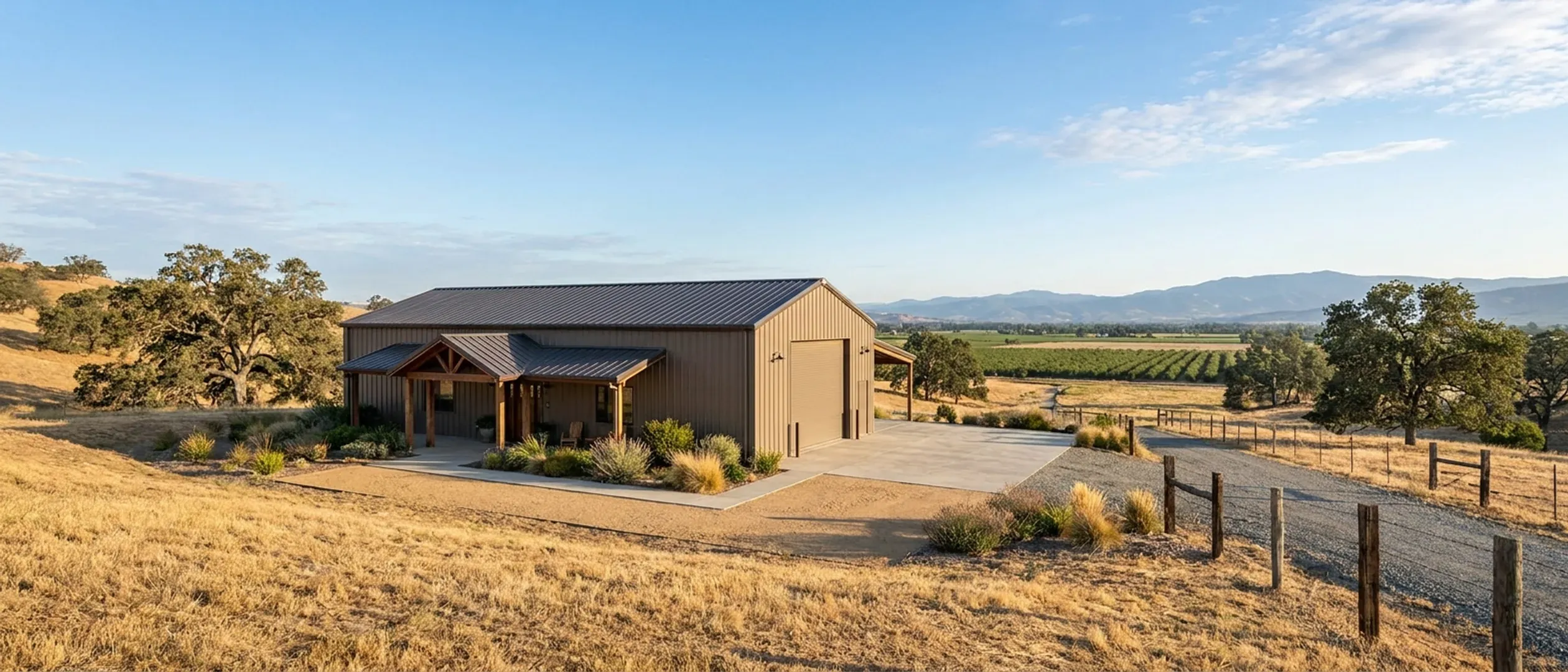
Barndominium Financing in California
There is no loan product called a barndominium loan. A barndominium you live in is financed the way any new house is: a construction loan that pays the builder in draws, converted or refinanced into a mortgage when the house is finished. What makes it harder is the appraisal. A lender lends against what an appraiser says the finished house is worth, and an appraiser needs comparable sales, which are scarce for a steel or pole barn home on rural land. This guide sets out the published rules that govern those loans (Fannie Mae's Selling Guide and USDA's regulations), the rural lenders that serve California and say they finance barndominiums, CalHFA's program for owners rebuilding after a disaster, and what California's licence law means for an owner-builder who needs a loan. We do not arrange loans, and nothing here is a rate quote.
Figures on this page are cited third-party or government data, not a quote from California Barndominium Builders.
Bottom Line Up Front
- The usual route is a construction-to-permanent loan. Under Fannie Mae's rules the construction period can have no single period longer than 12 months and may not exceed 18 months in total, and the loan is sized on the lesser of the total cost or the as-completed appraised value.
- The appraisal is the hard part. Fannie Mae lets appraisers use less similar or older comparable sales where true comparables are scarce, and requires the lender to decide whether a property with large barns or outbuildings is residential in nature.
- Rural lenders say they do this. AgWest Farm Credit, one of seven Farm Credit institutions listed for California, names shop-homes and barndominiums among the properties it finances, and American AgCredit's rural home loans let barns and shops count in the appraised value.
What actually moves the number
The interest rate when you lock
Freddie Mac's survey put the average 30-year fixed mortgage rate at 7.03 percent in the week of 24 September 2026, against 6.30 percent a year earlier (25 September 2025). Construction loans are priced separately by each lender; ask when the rate on the permanent loan is set.
Whether you already own the land
Under Fannie Mae's single-closing rules, a borrower who already owns the lot is financed on the as-completed appraised value, while one buying the lot is financed on the lesser of the total cost and the as-completed value.
The as-completed appraisal
The loan follows the appraiser's value of the finished house and land, not the cost to build it. If the appraisal comes in below cost, the difference comes from your cash.
How big the shop is
Fannie Mae treats significant outbuildings such as large barns and storage areas as a sign a property may be agricultural, and the lender must decide whether it is residential in nature. A very large shop can change which loan fits.
Barndominium loans: what actually exists
Every option below is a mortgage or construction loan for a house. Barndominium is a style, not a loan category.
Construction-to-permanent, one closing
One loan, one closing: the lender pays construction in draws and the loan converts to a permanent mortgage when the house is finished. American AgCredit's rural home loans describe this as one loan, one set of fees and one closing, with interest-only payments during construction and the rate locked during construction.
Construction loan, then a mortgage (two closings)
A short-term construction loan is paid off by a separate permanent mortgage at completion. Fannie Mae's Selling Guide says it does not purchase the construction loan itself, and the permanent loan may come from a different lender than the one that funded construction.
Land or lot loans
If you are buying the land before you are ready to build, a lot loan comes first. American AgCredit's rural home loans say improvements like power, well and septic are not typically required for a lot loan, and that the lot loan can be switched into a construction loan when you are ready to build.
Paying cash
The Census Bureau counted 32 percent of contractor-built houses started in the West region in 2025 as paid in cash, against 65 percent financed conventionally. Owners who build in stages often pay for the shell in cash and finance the finish.
Construction-to-permanent loans: the Fannie Mae rules
Many lenders sell their mortgages to Fannie Mae, so its Selling Guide sets the terms most construction-to-permanent loans follow. Your lender may add its own conditions.
12 months per period, 18 months in total
For single-closing loans, the construction period may have no single period of more than 12 months and may not exceed 18 months in total, and after conversion the loan term may not exceed 30 years.
How the loan is sized
If you are buying the lot, the loan-to-value ratio is calculated on the lesser of the purchase price (construction cost plus lot price) and the as-completed appraised value. If you already own the lot, it is calculated on the as-completed appraised value.
Documents go stale
Credit documents must be no more than four months old at the closing of the construction loan, and income, employment and credit documents no more than four months old at conversion, with a limited exception. A long build can mean re-qualifying at the end.
No cash-out
Fannie Mae says cash-out refinance transactions are not eligible for single-closing construction-to-permanent mortgages. Plan the budget without drawing equity out of the land at closing.
The appraisal problem, and what the rules allow
The appraisal decides the loan. These are the Fannie Mae provisions an appraiser and lender work within for an unusual house.
Few comparable sales
Where there is a shortage of truly comparable sales, because of the nature of the property or few sales nearby, the appraiser may need to use properties that are not truly comparable, and in a rural area with minimal sales activity may use older sales if the report explains why.
Unique housing is eligible
Loans on unique or nontraditional housing are eligible for sale to Fannie Mae provided the appraiser has adequate information to develop a reliable opinion of market value, and it is not necessary for a comparable sale to be of the same design.
The shop and the barn
Minimal outbuildings are acceptable. Significant outbuildings such as large barns and storage areas may indicate the property is agricultural, and the lender must determine whether it is residential in nature. Describe the shop as part of the home.
Help the appraiser
Give the appraiser the plans, the specification and the finish schedule, and point to finished homes rather than bare shells. American AgCredit's rural home loans say barns, shops, outbuildings or riding areas can be included in the appraised value.
USDA Rural Development: what the rules allow
USDA's single-family housing loans can fund building a home in eligible rural areas. The regulations set conditions a barndominium has to meet like any house.
Direct loans can fund building
Under 7 CFR 3550.52, section 502 direct loan funds may be used to buy, build, rehabilitate, improve or relocate an eligible dwelling for use as the borrower's permanent residence. Under 3550.57 the house must be modest for the area and not designed for income-producing purposes.
Guaranteed loans cover construction and site work
Under 7 CFR 3555.101, guaranteed loan funds may be used for the construction or purchase of a new dwelling, and eligible costs include site preparation such as grading, the foundation and the driveway.
The site rules
Under 3555.201, the site must be typical in size for the area, must not include income-producing land or buildings, must have direct access from a hard-surfaced or all-weather road, and must have adequate utilities, water and wastewater systems. Property used primarily for agriculture is ineligible.
Check the address
USDA guarantees loans only in areas it designates as rural. Its income and property eligibility site lets you check an address before you apply.
How to finance a barndominium in California, step by step
The order matters, because each step feeds the next.
1. Talk to a lender before you buy land
Ask whether it finances barndominiums, owner-builders and large shops, and what it needs to see. A rural lender such as a Farm Credit institution is a good second call if a bank says no.
2. Get plans, engineering and a written budget
The lender sizes the loan on plans and a budget. A steel-frame home needs stamped structural plans; the custom plans page covers the drawings.
3. Confirm the permit path
Zoning, septic, well and the fire hazard zone all affect whether and what you can build. Read can you build a barndominium in California? and our permitting page.
4. Budget for a gap
If the appraisal comes in below cost, the difference comes from your cash. The cost guide and size-for-budget guide help set a budget with room for it.
Reading this because you are weighing a build? The next step is a plan drawn for your program.
What's different about California
Farm Credit lenders serve California
Farm Credit's own state page lists seven institutions for California: AgWest Farm Credit, American AgCredit, CoBank, Colusa-Glenn Farm Credit, Fresno Madera Farm Credit, Golden State Farm Credit and Yosemite Farm Credit. AgWest's home loan page names manufactured, modular, log homes, shop-homes and barndominiums among the properties it finances, including acreage without water, power or septic.
CalHFA helps buyers, and owners rebuilding after a disaster
CalHFA's loan programs are for buying a home in California, with down payment assistance through approved lenders. Its Disaster Rebuilding Assistance Program is the construction exception: it offers financing tools such as interest rate buydowns to low- to moderate-income homeowners rebuilding a primary residence they owned and lived in at the time of a disaster. CalHFA is not a direct lender; its programs go through approved loan officers.
Owner-builders still need a willing lender
You can act as an owner-builder on your own land, doing the work yourself or hiring licensed trades directly, and you sign an owner-builder declaration with the permit. The licence law also treats a paid consultant to an owner-builder as a contractor. Whether a lender will fund an owner-built house is the lender's decision, so ask before you plan to build it yourself.
Stamped plans and a permit come first
A construction lender needs plans and a budget before it lends. In California a steel-frame home needs structural plans stamped by a licensed engineer or architect, and your city's building department issues the permit inside city limits; in unincorporated areas it is the county's.
Pros and cons, honestly
Pros
- One-closing construction-to-permanent loans mean one set of fees.
- If you already own the land, Fannie Mae's rules size the loan on the as-completed appraised value.
- Rural lenders in California say they finance shop-homes and barndominiums.
- USDA's rules allow its loans to fund new construction in eligible rural areas.
Cons
- Appraisals can be harder where there are few comparable sales.
- A very large shop can make a property look agricultural to a lender.
- Construction periods are capped, so delays can mean re-qualifying.
- Lenders set their own rules on owner-built homes.
Can you get a mortgage on a barndominium in California?
What is a construction-to-permanent loan?
Which lenders finance barndominiums in California?
Can I get a USDA loan for a barndominium?
Does CalHFA finance barndominium construction?
Can an owner-builder get a construction loan in California?
What are barndominium loan rates?
Questions answered? Tell us what you want to build and we will put real numbers against it.
Sources
- Fannie Mae Selling Guide B5-3.1-02, Conversion of Construction-to-Permanent Financing: Single-Closing Transactions (05/06/2026)
- Fannie Mae Selling Guide B5-3.1-03, Conversion of Construction-to-Permanent Financing: Two-Closing Transactions
- Fannie Mae Selling Guide B4-1.3-08, Comparable Sales
- Fannie Mae Selling Guide B4-1.3-05, Improvements Section of the Appraisal Report
- Freddie Mac, Primary Mortgage Market Survey history — weeks of 25 Sep 2025 and 24 Sep 2026
- U.S. Census Bureau, Characteristics of New Housing: contractor-built houses started by type of financing
- eCFR, 7 CFR 3550.52, Loan purposes (section 502 direct loans)
- eCFR, 7 CFR 3550.57, Dwelling requirements
- eCFR, 7 CFR 3555.101, Loan purposes (guaranteed loans)
- eCFR, 7 CFR 3555.201, Site requirements
- USDA Income and Property Eligibility Site
- Farm Credit, California
- AgWest Farm Credit, Home Loans
- American AgCredit, Rural Home Loans
- CalHFA, Homebuyers Loan Programs
- CalHFA, Disaster Rebuilding Assistance Program
- California Business and Professions Code Section 7044 (owner-builders)
- California Business and Professions Code Section 7026.1 (consultant to an owner-builder)
- California Business and Professions Code Section 6737.1
Keep reading
The pages that answer the next question this one raises.
How much does it cost to build a barndominium in California?
The published figures a lender's budget review will be measured against.
Read itWhat size can you build for your budget?
Set a size the loan and your cash can carry.
Read itCan you build a barndominium in California?
The permit path a lender will ask about.
Read itStart the survey
Tell us about your land and what you want to build.
Read itWant a real number instead of a range?
Start the survey and tell us about your land and what you want to build. Include the county and parcel number (APN) if you have them, because in California the zoning, the fire hazard zone, the septic and well answers and the local fees change the budget as much as the building does. The survey costs nothing.