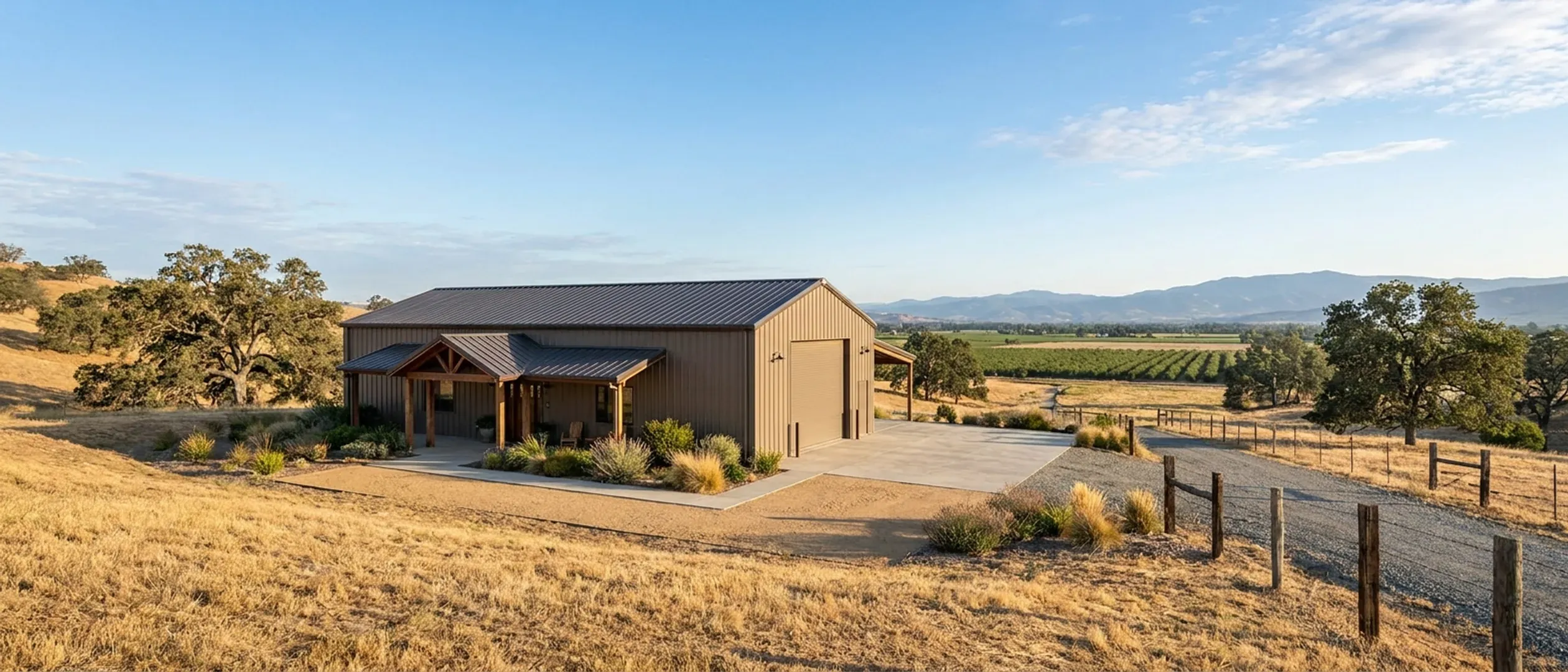
What Size Barndominium Can You Afford in California?
The question is usually asked as a size (how big can I build for $300,000?) but it is answered as a subtraction. Before the building gets a dollar, the budget has to cover the land, the site work, and the lines California attaches to every new house: a school facilities fee charged per square foot, local permit and development fees, and, on rural land, a septic system and a well. What is left is divided by a published cost per square foot, and the finish level you choose decides which end of that range you land on. This guide walks through the three steps with figures other people publish: HomeGuide's barndominium estimates, the Census Bureau's measured contract prices for the West region, and USDA's 2026 land values. It is a method for your own numbers, not a quote.
Figures below are industry data from cited third-party sources, not a quote from California Barndominium Builders. Every project is priced individually.
Bottom Line Up Front
- Take land and site costs off the top first. HomeGuide says bringing utilities, clearing and access to a rural lot can reach $75,000, and USDA's 2026 averages for California farm land run from $4,250 an acre for pasture to $21,500 for irrigated cropland.
- Divide what is left by a published cost per square foot. At HomeGuide's California range of $71 to $174, $200,000 builds roughly 1,150 to 2,800 square feet and $300,000 roughly 1,720 to 4,200; at the Census 2025 West median contract price of $176.87, about 1,130 and 1,700.
- Unfinished shop space stretches the footprint, because it skips most of the interior and systems costs that NAHB found make up more than 43 percent of a new home's construction cost.
Published cost figures
Third-party and government figures, each with its source. None of them is a quote, and none of them is ours.
| Measure | Range | Source |
|---|---|---|
| Barndominium built and finished, California row of HomeGuide's cost-by-state table (2026) | $71–$174 per sq ft | HomeGuide, How Much Does a Barndominium Cost to Build? (2026), https://homeguide.com/costs/barndominium-cost |
| Houses built by a general contractor on the owner's land, West region (includes California), started in 2025: median to average contract price, land excluded | $176.87–$213.85 per sq ft | U.S. Census Bureau, Characteristics of New Housing, contract price per square foot (2025), https://www.census.gov/construction/chars/xls/contractpricesqft_cust.xls |
| Barndominium kit including the shell and on-site assembly only (HomeGuide, 2026) | $30–$50 per sq ft | HomeGuide, Barndominium kit prices, https://homeguide.com/costs/barndominium-cost |
Total cost by size
Rough totals at common sizes. These move with everything on this page, so treat them as a starting orientation, not an estimate for your project.
1,000 sq ft
$71,000–$174,000
Arithmetic: 1,000 sq ft x HomeGuide's California range of $71 to $174 per sq ft (2026), building only. https://homeguide.com/costs/barndominium-cost
1,500 sq ft
$106,500–$261,000
Arithmetic: 1,500 sq ft x HomeGuide's California range of $71 to $174 per sq ft (2026), building only. https://homeguide.com/costs/barndominium-cost
2,000 sq ft
$142,000–$348,000
Arithmetic: 2,000 sq ft x HomeGuide's California range of $71 to $174 per sq ft (2026), building only. https://homeguide.com/costs/barndominium-cost
2,500 sq ft
$177,500–$435,000
Arithmetic: 2,500 sq ft x HomeGuide's California range of $71 to $174 per sq ft (2026), building only. https://homeguide.com/costs/barndominium-cost
What actually moves the number
Land first
USDA's 2026 figures for California farm real estate average $14,100 an acre, from $4,250 for pasture to $21,500 for irrigated cropland. If you already own the land, this line is zero and the whole budget goes further.
Septic, well and power
Septic systems are permitted locally, usually by county environmental health, and wells by the county and a C-57 licensed well contractor. There is no statewide price for either; HomeGuide puts the cost of bringing utilities, clearing and access to a rural lot at up to $75,000.
Fees that grow with size
School districts can charge impact fees on new homes, and they are charged on the new floor area, so a bigger house pays more. Ask your school district for its rate before you size the house.
The finish level
The same budget builds more than twice the floor area at the bottom of HomeGuide's California range as at the top. Where you land depends on the kitchen, the flooring, the systems and how much of the building you finish.
Step 1: take the land and site costs off the top
Everything the building does not own comes first. Our site preparation page covers what the site work involves.
Land
If you are buying, the land price comes first. USDA publishes California averages only for farm land: $4,250 an acre for pasture, $8,150 for non-irrigated cropland and $21,500 for irrigated cropland in 2026. A residential parcel is priced by its own market, so use recent sales and the county assessor.
Utilities and access
On a rural parcel, budget the septic system, the well, the power connection and the driveway before the building. HomeGuide puts clearing land at $1,200 to $8,000, a gravel road at $4 to $10 per square foot, and total rural lot development at up to $75,000.
Fees
Add the building permit, plan check, the school impact fee and any city development and connection fees. The Terner Center measured city development fees of $21,000 to $157,000 per single-family home across seven California cities in 2018; a city or county that charges residential permit fees must post its schedule online.
Plans and engineering
A steel-frame home needs structural plans stamped by a licensed engineer or architect. HomeGuide lists stock barndominium plans at $1,300 to $2,000 and custom plans at $4,500 to $6,000 or more, and a structural engineer at $100 to $220 an hour.
Step 2: divide what is left by a published cost per square foot
Pick the figure that matches the finish you want. The low end of HomeGuide's range is a basic finish; the Census median is what finished custom houses in the West actually cost.
Can I build a barndominium for $100,000?
At HomeGuide's California range, $100,000 for the building covers roughly 575 to 1,400 square feet. At the Census West median contract price it covers about 565. That is a shell, a small cabin-sized building or a large shop with a modest living area, not a finished family home.
What $200,000 builds
At HomeGuide's California range, roughly 1,150 to 2,800 square feet. At the Census West median of $176.87, about 1,130 square feet, and at the average of $213.85, about 935.
How big a barndominium can I build for $300,000?
At HomeGuide's California range, roughly 1,720 to 4,200 square feet. At the Census West median, about 1,700 square feet, and at the average, about 1,400. For comparison, the Census median size of a contractor-built house completed in the West in 2025 was 2,354 square feet.
What a kit changes
HomeGuide prices a kit with the shell assembled at $30 to $50 per square foot, but that excludes the foundation, utilities and every interior finish. A kit budget buys a large shell; finishing it costs the rest of the range.
Check the answer against the fees
Once you have a size, ask the school district for its impact fee rate and the city or county for its permit and development fees, and add them back into Step 1. School districts can charge impact fees on new homes, so a larger house carries a larger fee.
Step 3: stretch the footprint with unfinished space
The cheapest square foot is the one you do not finish. See the barndominium with shop and small barndominium plans, and our shouses page.
Shop and garage bays
In NAHB's 2024 survey, interior finishes were 24.1 percent of construction cost and the plumbing, electrical and HVAC rough-ins 19.2 percent. A shop bay skips most of both, so a building with a large shop costs less per total square foot than one finished throughout.
Finish in stages
Build the full shell, finish the living area first, and leave a loft or bonus room for later. The permit and inspections still cover what you finish later, so plan it with the building department at the start.
Keep the shape simple
A rectangle with one roof line uses the frame most efficiently. Wings, dormers and complex rooflines add framing, roofing and engineering.
Size the living space to the household
Every finished square foot also carries its share of the sprinkler system, the solar system sized to the conditioned floor area, and the school impact fee. A smaller finished area lowers all three.
Reading this because you are weighing a build? The next step is a plan drawn for your program.
What's different about California
Sprinklers and solar come out of the building budget
New one- and two-family homes in California need an automatic fire sprinkler system (California Residential Code R309), installed by a licensed fire-protection contractor, and under the 2025 Energy Code a new single-family home generally needs a solar PV system sized by a state formula. Both scale with the house, so a smaller house carries smaller versions of both.
Wildfire rules can change the material budget
In Fire Hazard Severity Zones, homes are built to the California Wildland-Urban Interface Code (Part 7 of Title 24), which covers Class A roofs, eaves, vents, exterior walls, windows, doors and decks. Check your parcel on the State Fire Marshal's Fire Hazard Severity Zone viewer before you set the budget.
The land-use answer comes before the size
Williamson Act land is restricted to farming and county-approved compatible uses in return for lower property taxes; whether you can build a home depends on the county's rules. In the Coastal Zone, building needs a coastal development permit as well as the building permit. Settle both before you size the house.
A second unit on an existing lot
California's ADU law requires qualifying accessory dwelling units to be approved ministerially, without a hearing, under the city's or county's objective standards. A small barndominium-style unit behind an existing home is a different budget from a new house on raw land, because the land and many site costs are already paid.
Pros and cons, honestly
Pros
- Owning the land already puts the whole budget into the building.
- Shop space under the same roof adds footprint for much less than living space.
- A kit lets you buy the shell first and finish in stages.
- A simple rectangle keeps the frame and roof efficient.
Cons
- Land, site work and fees can take a large share of the budget before the building starts.
- Fees and the solar requirement grow with the size of the house.
- Rural parcels usually need septic, a well and power.
- A steel frame needs stamped structural plans.
How big a barndominium can I build for $200,000 in California?
How big a barndominium can I build for $300,000?
Can I build a barndominium for $100,000 in California?
What should I budget before the building?
Does a bigger house cost more in fees in California?
How do I make my budget go further?
Can you tell me what size fits my budget?
Questions answered? Tell us what you want to build and we will put real numbers against it.
Sources
- HomeGuide, How Much Does a Barndominium Cost to Build? (2026) — California range, kit prices, land and plan costs; read 27 Sep 2026
- U.S. Census Bureau, Characteristics of New Housing: contract price per square foot
- U.S. Census Bureau, Characteristics of New Housing: square feet of floor area
- NAHB, Cost of Constructing a Home 2024 (January 2025)
- USDA NASS, Land Values 2026 Summary (July 2026)
- Terner Center for Housing Innovation, It All Adds Up (March 2018)
- 2025 California Residential Code, Title 24, Part 2.5 (ICC Digital Codes)
- California Energy Commission, 2025 Building Energy Efficiency Standards
- 2025 California Wildland-Urban Interface Code, Title 24, Part 7 (ICC Digital Codes)
- Office of the State Fire Marshal, Fire Hazard Severity Zones
- California Department of Conservation, Williamson Act Program
- California Government Code Section 66317 (ADU applications approved ministerially)
- California Public Resources Code Section 30600 (coastal development permit)
- State Water Resources Control Board, Onsite Wastewater Treatment Systems (OWTS Policy)
- California Business and Professions Code Section 6737.1
- California Education Code Section 17620 (school facilities fees)
Keep reading
The pages that answer the next question this one raises.
How much does it cost to build a barndominium in California?
Cost per square foot, shell vs turnkey, and the California cost lines.
Read itBarndominium vs house cost
Where the frame saves money and where it does not.
Read itBarndominium financing in California
How a construction loan sizes to the appraisal.
Read itStart the survey
Tell us about your land, your budget and what you want to build.
Read itWant a real number instead of a range?
Start the survey and tell us about your land and what you want to build. Include the county and parcel number (APN) if you have them, because in California the zoning, the fire hazard zone, the septic and well answers and the local fees change the budget as much as the building does. The survey costs nothing.